
Ep 41 - Online Education Is Real Education: Florida’s New Rule, ABA Control, and the Domino Effect
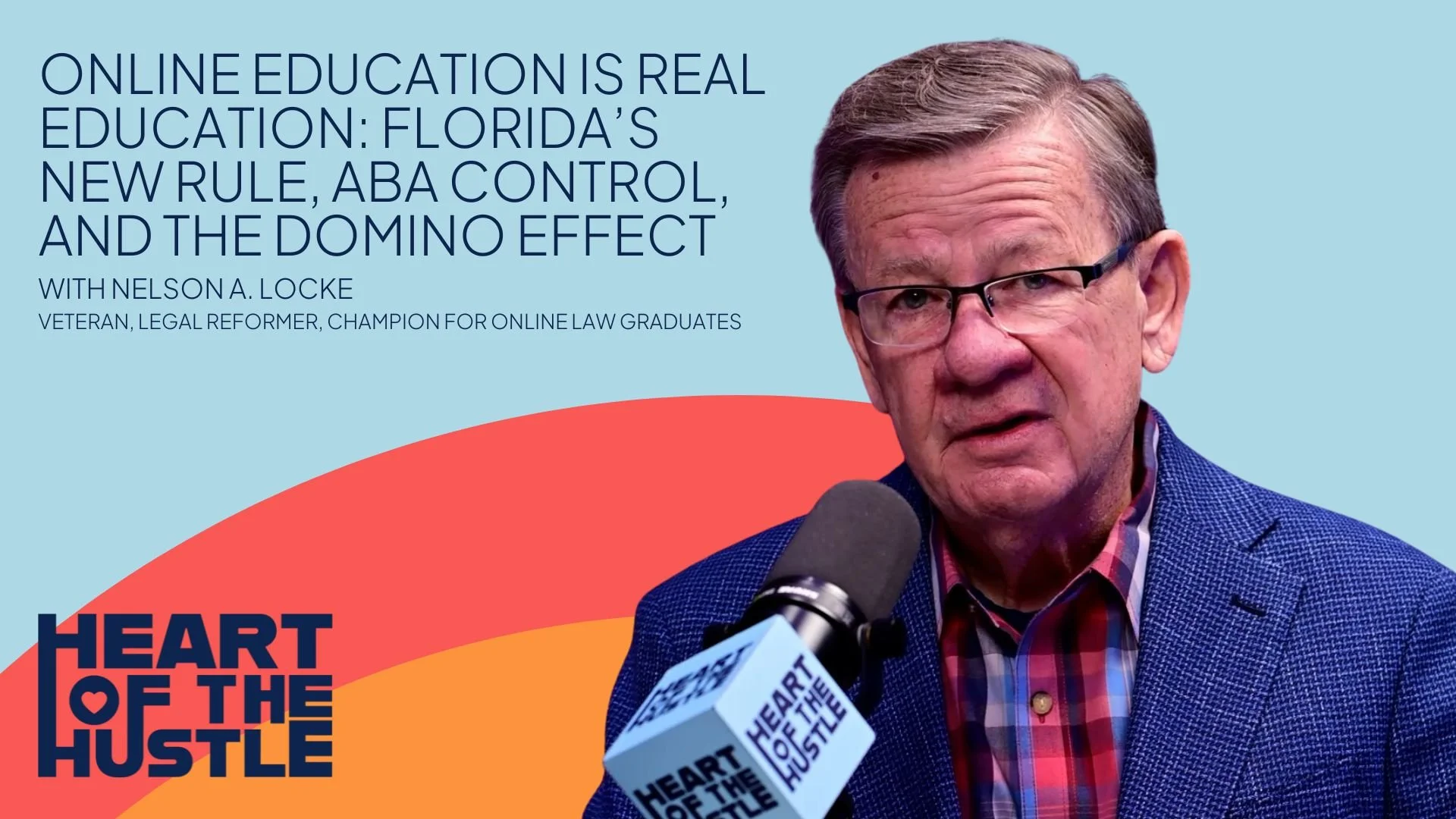
🌐 Website: https://lockelaw.us/
By Sherry Sutton | Heart of the Hustle Show
Florida updated bar admissions language on January 15, 2026. In Part 2 of my 3rd interview with Nelson Locke, we break down what it means for online law school access.
When a guest comes back a third time… you know it’s not small news
This is Part 2 of my third interview with attorney Nelson A. Locke — and if you’ve listened to any of our previous conversations, you already know why.
Nelson doesn’t show up for fluff. He shows up when something is shifting in real time — and right now, the rules around legal education, bar admissions, and who gets to “count” are shifting fast.
Part 1 was about the spark. This episode is about the spread.
Because Texas wasn’t the end of the story.
It was the beginning of the domino effect.
And one of the biggest dominos wobbling next is Florida.
The headline: Florida made a move on January 15, 2026
In Part 2, Nelson breaks down Florida Supreme Court Rule 2025-264, dated January 15, 2026 — and why its updated language matters for anyone paying attention to online law school access and legal education reform.
If you’re not a lawyer, don’t click away. This is not just a legal industry issue.
This is a “who gets to decide what counts” issue.
Which is basically every industry right now.
Why this conversation is bigger than online law school
People try to reduce this debate to a lazy soundbite:
“Online school isn’t real.”
That argument is outdated, and honestly, it’s convenient for people who benefit from keeping the old system exactly as it is.
This conversation is not about whether a person attended class inside a building.
This is about legitimacy, access, and power.
It’s about whether someone is evaluated based on:
competence and performance, or
prestige and gatekeeping
Nelson’s position is very simple:
If someone can pass the bar exam and practice competently in good standing, that should matter more than how the education was delivered.
That is a performance-based argument.
And it is incredibly hard to dismiss if your goal is actually public protection.
Florida’s rule change and the definition that matters most: “accredited law school”
In legal world, definitions are where the game is played.
Florida amended its definition of an “accredited law school” to include accreditation via:
a recognized programmatic accrediting agency for legal education, and
a recognized institutional accrediting agency for higher education (with additional court approval language)
Translation: Florida is at least signaling willingness to consider a broader framework than “ABA-only.”
Is it perfect? No. Nelson is very clear about what is still unclear.
But it is movement.
And movement is the point.
The mess that still needs clarity: “distance education” vs “online education”
This part matters more than people realize.
Florida’s language includes a reference to “distance education,” and Nelson explains why that is a problem if it is not clarified.
Because “distance education” is often treated like a synonym for “online education,” but it is not.
Distance education can carry an old-school assumption: correspondence-style learning, low engagement, limited oversight.
Modern online education is often professor-led, interactive, structured, and rigorous.
So when rules use outdated terms without defining them, qualified people get trapped in a vocabulary debate instead of being evaluated on competence.
If Florida wants to modernize, it has to clean up the language.
The policy detail that can still block qualified attorneys: the accreditation timing rule
Here’s where Nelson draws a hard line.
Florida’s update does not appear to change an “existing requirement” tied to when a school must be accredited relative to graduation (including a timing window that can disqualify applicants based on accreditation timing).
And this is where the logic breaks down.
Because a school can become accredited after someone graduates.
Someone can pass a bar exam.
Someone can practice in good standing.
And yet, a technical timing rule can still block them.
That is not measuring competence.
That is measuring bureaucracy.
If the point of admissions is public protection, then the evidence should be performance-based:
bar passage
good standing
proven competent practice
Not a calendar technicality.
Why Nelson keeps bringing up California
In this episode, Nelson also points to California as an example of a system that has been more flexible and more modern about recognizing different pathways.
Not because California is perfect.
But because it proves a point:
A state can evaluate legal education and competence without relying exclusively on ABA approval.
And once one state proves something is possible, “impossible” stops being a credible excuse everywhere else.
The access-to-justice reality: rural communities, cost, and the legal pipeline
One of the most important parts of this conversation is the access angle.
Online education is not just about convenience. It is about removing barriers.
If someone lives in a rural area and the nearest “approved” school is hundreds of miles away, the cost and logistics can make the “traditional path” impossible.
Online legal education can reduce:
relocation costs
commuting burdens
barriers for working adults
barriers for parents and caregivers
And the downstream effect is bigger than the student.
It impacts communities.
Because more qualified attorneys can serve people who currently do not have easy access to legal help.
If we care about access to justice, we cannot keep treating modern education as inherently suspicious.
The bar exam issue: why require another one when competence is already proven?
Nelson also raises concerns about Florida’s approach to bar exam requirements and waiver paths.
The question is straightforward:
If someone has already passed a bar exam, has valid scores, and is in good standing, why force them through another full bar exam as a blanket requirement?
Again, the theme stays consistent:
Performance should matter.
Competence should matter.
Not hoops for the sake of hoops.
Why this is Nelson’s third time on the show
Because this story is evolving in real time.
Each time Nelson comes back, the landscape has moved.
And this Part 2 episode is exactly that: an update, a breakdown, and a warning shot that more changes are coming.
Texas moved.
Florida is moving.
Other states are watching.
And if you are in online law school, considering it, or already practicing and dealing with admissions barriers, you need to keep your eyes on the states — not just the institutions.
Want to connect with Nelson?
You can learn more at: lockelaw.us
And if you want the full episode, listen to Part 2 of my 3rd interview with Nelson Locke on Heart of the Hustle.
Because online education is real education.
And the dominoes are finally starting to fall.
Nelson’s third time on Heart of the Hustle is proof that one story can create real momentum. When you share the truth clearly and consistently, it doesn’t just inspire people — it gives them permission to act.
If you’re building something that deserves a bigger stage, I’d love to feature you on Heart of the Hustle. And if you want help turning your story into podcasts, clips, and months of marketing, the Heart of the Hustle Studio is where we do that.
Be a guest: https://www.sherrysutton.com/heartofthehustlevodcastapplication
Disclaimer: Attorney Locke is a member of the California Bar (293842) and the Texas Bar (24147328). His principal office is in Plano, Texas 75024.
