
Ep 49 - You Can't See the Label From Inside the Bottle
🌐 Website: https://www.bsharpe.net/
By Sherry Sutton | Heart of the Hustle Show · A conversation with leadership strategist Benita Sharpe on career growth, coaching, and the strengths you already have.
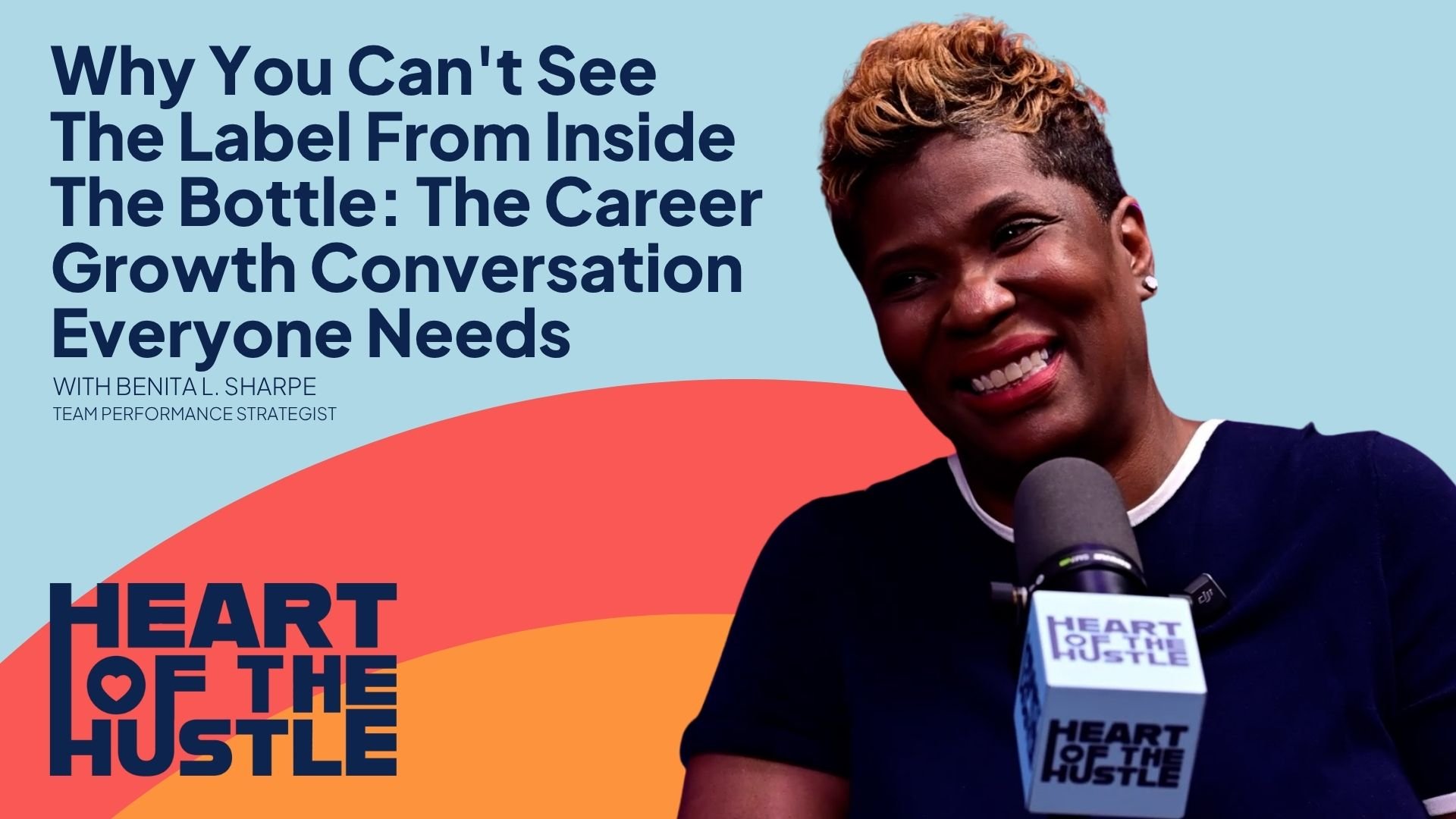
Some conversations stay with you long after the cameras stop rolling. Hosting Heart of the Hustle has put me across the table from entrepreneurs, business owners, creatives, and leaders in just about every industry you can name, and most of them send me home with something useful: a strategy, a reframe, a story I keep retelling. But every so often a guest does something different. They quietly change the way you see yourself. My conversation with Benita Sharpe was one of those.
Benita is a leadership strategist, speaker, coach, and consultant, and she has built her career around helping people lead better, communicate better, and trust themselves more. We covered a lot of ground together: leadership development, team performance, coaching, communication styles, career growth. But underneath all of it ran one stubborn, simple idea. Most people have no clue how capable they actually are.
That sounds almost backwards in a world that runs on personal branding and self-promotion. And yet some of the most talented people I know still cannot see their own value. They notice their weaknesses before their strengths, fixate on what they have not done instead of what they have, and measure themselves against everyone else instead of appreciating the experience and perspective only they bring. It shows up constantly in entrepreneurs and high achievers, the very people who spend so much energy chasing growth that they forget to clock how far they have already come.
When you're standing inside your own experience, your gifts get blurry. The people around you usually spot your strengths long before you do.
At one point I dropped a phrase I have been saying for years: you can't see the label from inside the bottle. It lands because it is true. The strengths are there. What's missing is perspective.
Career Growth Is About More Than Promotions and Raises
When most of us picture career growth, we picture a bigger title, a fatter paycheck, more responsibility. Those things matter, no argument. But real growth runs deeper than a new line on a business card. It starts with self-awareness, the moment you stop asking "what position do I want next?" and start asking "who do I need to become?" That one swap changes the whole game.
Part of what makes Benita such a sharp coach is that she gets this. Sustainable growth is always rooted in personal development. Before you can lead well, you have to understand yourself. Before you can manage a team, you have to understand how you communicate. And before you reach the next rung, you have to get honest about the beliefs and habits that are either carrying you forward or quietly holding you back.
The trap a lot of professionals fall into is hunting for external fixes while ignoring the internal ones. They go to the conferences, collect the certifications, and inhale every podcast and book they can find, but they never stop to examine the story running in the background. The story about not being qualified enough, experienced enough, or ready yet, and the one about what everyone else will think. Those stories shape a career far more than any technical skill, because a brilliant professional who doubts herself will hold herself back every time. That's why confidence matters. Not because it conjures success out of thin air, but because it lets you actually use the strengths you already have.
The Leadership Lesson Hidden in Being Called "Bossy"
One of my favorite moments came when Benita talked about being called bossy as a kid. Most women hear that and nod immediately. Little girls who show leadership get labeled bossy, too loud, too opinionated, too much, while boys doing the exact same things get called natural leaders. Those early messages stick. Over the years a lot of women learn to shrink, softening their opinions, second-guessing their instincts, and becoming hyper-aware of how they are coming across. The end result is talented leaders spending years muffling the very traits that would have helped them thrive.
What I loved is that Benita reads those childhood memories differently now. She wasn't bossy. She was organizing people, building structure, driving action, solving problems. She was practicing leadership years before she had a title to prove it. That's the reminder for anyone working on their own leadership development: it doesn't switch on the day you get promoted. It shows up early, in habits and instincts, long before the org chart catches up. The work isn't becoming someone else. It's learning to channel what's already yours.
Great Leaders Focus on People Before Performance
In business we are trained to watch the numbers. Revenue, productivity, efficiency, output. Those measurements matter, but they only tell part of the story, because behind every metric is an actual human being with their own motivations, worries, and circumstances. Benita's whole approach to leadership reflects that. Instead of staring at the dashboard, she looks at the people, asking what is really going on under the surface. Why is someone struggling? Where is the resistance coming from? What support is missing, and which conversation has not happened yet?
That matters more than ever right now. People are not showing up just for a paycheck anymore. They want connection, purpose, and leaders who actually care whether they grow. When someone feels valued they get more engaged, and engagement is what quietly drives performance up and results along with it. The link between how you lead and how your team performs is stronger than most people give it credit for. The best leaders never forget that business is, at bottom, about people, and people do their best work when they feel seen.
The Hidden Cost of Underperforming Teams
When results start slipping, most organizations reach straight for the productivity lever. They pull reports, scrutinize metrics, roll out a new system. Those tools have their place, but Benita pointed out what a lot of leaders miss: underperformance usually isn't a productivity problem, it's a people problem. Every struggling team has a story behind the numbers. Sometimes it's broken communication or missing trust. Sometimes people never got the training they needed, or the expectations were never made clear, or they simply don't feel connected to the work in front of them.
The mistake is treating symptoms instead of diagnosing the cause. When a team stalls, the instinct is to push harder. More accountability, more meetings, more pressure. But pressure rarely fixes anything rooted in confusion or disengagement. Benita starts somewhere else entirely, with curiosity. Rather than "why aren't these people performing," she asks "what's getting in the way of their success?" It's a small shift in wording and a huge shift in outcome, because performance is so often a reflection of leadership. Teams don't operate in a vacuum. They respond to the environment around them, and when leaders focus on understanding people instead of just managing outcomes, performance tends to climb on its own. It isn't magic. It's leadership.
Why Every Professional Needs a Coach
One of my favorite stories from the episode was how Benita became a coach in the first place. She almost didn't. A friend invited her into a coaching program and her instant reaction was, "I don't know how to be a coach." Her friend just looked at her and said, "You do it every day." I have watched this play out with entrepreneurs and executives over and over. The things we are naturally good at feel ordinary to us, so we assume everyone can do them and everyone thinks the way we do. They can't, and they don't. What feels effortless to you is often exactly the thing someone else would pay handsomely to learn.
Coaching exists because perspective is valuable. Athletes have coaches, so do executives, speakers, and entrepreneurs, and not because any of them are failing. They are growing. That's the misconception worth killing: coaching isn't a last resort for people who are struggling. It's frequently most useful when things are already going well, because that's when it helps you go from good to great, catch blind spots before they harden into obstacles, and see possibilities you would otherwise miss. That's why it remains one of the most powerful tools out there for leadership development and career growth.
We're All a Little Bit Junk Drawer
Of all the analogies Benita reached for, this is the one I can't shake. She described people as junk drawers. Most of us have one somewhere in the house, stuffed with dead batteries, tangled cords, expired coupons, instruction manuals, and pens that quit working two years ago. Things we don't need and somehow never toss. The same thing happens between our ears. Over a lifetime we collect experiences, beliefs, criticisms, fears, and assumptions, and while some of it serves us, plenty of it doesn't, yet we keep hauling it around anyway. We cling to a comment somebody made years ago, remember our failures in high definition while our wins go fuzzy, and quietly absorb criticism from people who were never qualified to judge us in the first place.
Eventually all that clutter starts burying the good stuff, and it gets hard to see your own talent under the layers of doubt. Benita's coaching is really about helping people clear out the drawer. Not because they are broken or short on potential, but because the potential is already in there. The challenge is clearing away everything that's hiding it. I love that distinction, because it means growth isn't always about adding something new. Sometimes it's about putting down what no longer belongs to you.
When Someone Shows You Your Own Receipts
Another line that stuck with me was when Benita talked about showing people their own receipts. Think about how casually we dismiss our own wins. We finish a brutal project and immediately move to the next one. We solve a huge problem and our attention snaps straight to what's still unfinished. We hit a goal we chased for years and barely pause to enjoy it before the brain pivots back to the to-do list. The result is a lot of genuinely accomplished people walking around feeling permanently behind, chasing growth while never acknowledging the progress already on the board.
This is where a good coach, mentor, or friend earns their keep. They hand you back your receipts. They point at the evidence: the challenges you cleared, the obstacles you navigated, the wins you actually built, the impact you actually made. It isn't about ego, it's about perspective. Confidence doesn't appear from nowhere. It usually gets built by noticing the proof that was already sitting there. When someone helps you see your own receipts, they are really just helping you get reacquainted with reality, and sometimes that's exactly what you need.
Communication Styles Can Make or Break a Team
Communication got a lot of airtime in this episode, especially the way different people process information so differently. Benita described herself as straight, no chaser, and that kind of self-awareness is gold for a leader. One of the fastest ways to manufacture conflict on a team is to assume everyone communicates the way you do. Some people process fast, others need a minute to think. Some want the direct version, others need the context first. Some come alive in a brainstorm, others do their best work with structure and prep time. None of those styles is wrong. They are just different.
The most effective leaders get this and adapt, learning to meet people where they are instead of expecting everyone to mirror them. That flexibility is what builds stronger relationships, smoother collaboration, and teams that actually function. Communication is one of the most underrated leadership skills going, and more often than not it's the thing that decides whether a team thrives or quietly falls apart.
The Easter Basket Story and the Courage to Just Start
One of the more fun stories Benita told was about a friend who wanted to launch a new product but kept hesitating because the big retailers already owned the category. She worried nobody would buy from her, that there wasn't room for her, that someone else was already doing it better. Sound familiar? Those exact fears show up in entrepreneurship all the time. We talk ourselves out of things by deciding the market is too crowded and somebody more qualified got there first.
Benita pushed back and told her to go for it. The result? It worked. Customers wanted it, people responded, the business found traction. The lesson is almost annoyingly simple: innovation rarely starts with certainty. It starts with a willingness to try. Plenty of entrepreneurs wait to feel fully confident before they move, but confidence usually shows up after the action, not before it. The people who build successful businesses aren't fearless. They are just willing to move while the fear is still in the room.
Why Community Accelerates Growth
Near the end of our conversation we got into community, which feels especially relevant right now. Entrepreneurship is lonely. So is leadership. Building something that matters often means making calls the people around you don't fully understand, and that's exactly why community is worth protecting. The right people give you encouragement, accountability, and perspective, and they remind you that you're not doing this alone.
I can trace a lot of the best opportunities in my own career straight back to relationships. Conversations, introductions, collaborations, partnerships. Growth almost never happens in isolation, it happens through connection, and it's one of the biggest reasons I love hosting this show. Every episode drops me into a conversation with someone doing meaningful work, every guest stretches my thinking, and every recording reminds me that success was never meant to be a solo sport. The people you surround yourself with shape how you think and what you believe is possible, so choose them on purpose.
Letting Go of Good to Make Room for Great
Some of the most powerful minutes of the whole conversation came when we got into what growth actually costs. Most people assume growth means adding something: a new opportunity, a new skill, a new title, a new revenue stream. But sometimes it asks for subtraction first. Sometimes the thing between you and where you want to be isn't something to gain, it's something to release, and that's uncomfortable precisely because what's holding us in place is usually good, not bad. A stable job. A familiar routine. A business model that still pays. A role you've quietly outgrown. A version of yourself that got you here.
That's the part that makes it hard. Walking away from something terrible is easy. Walking away from something comfortable and reasonably successful is a different beast, so we tell ourselves staying put is the practical move, that now isn't the right time, that we'll make the change later. But growth doesn't wait around for perfect timing. Sometimes it asks you to trust yourself enough to move before you feel completely ready, and that's true whether you're talking about leadership, a business, a career, or a life. Every real transformation starts with the same decision: to stop settling for comfortable and start chasing what's actually possible.
Why You Can't See the Label From Inside the Bottle
This episode took its title from that phrase I keep coming back to, and the longer I sit with it the more places it fits. It explains why leaders underestimate the impact they're having on the people around them. It explains why professionals lowball the value they bring to their organizations. It explains why business owners get so buried in the day-to-day that they lose sight of their own expertise, and why most of us know our flaws far more intimately than our strengths.
Perspective is the whole ballgame, which is exactly why mentorship, coaching, community, and trusted relationships matter so much. The people around us can see what's invisible to us: the patterns, the strengths, the opportunities, the potential. That doesn't mean outsourcing your self-worth to other people's opinions. It means staying open to perspective, because one of the most generous things anyone can do is help you see yourself a little more clearly. That's the work Benita has built her career on, whether she's with executives, entrepreneurs, teams, or brand-new leaders. She isn't creating potential. She's revealing what was already there, and that distinction is everything.
What Every Leader and Entrepreneur Can Take From This
A few lessons kept surfacing as I replayed the conversation. The first is that confidence isn't something you're handed at birth, it's what grows when you start recognizing the evidence of your own capability. The second is that leadership is fundamentally about people. Processes, systems, and metrics all matter, but people are what drive results, and the strongest leaders never lose sight of how much human connection still moves the needle in business.
The third is that growth demands self-awareness. If you want to get better professionally, you have to be willing to look honestly at your own communication style, strengths, weak spots, and blind spots. The fourth is that coaching accelerates all of it. Whether it's a mentor, a consultant, or a trusted friend, an outside view helps you find the opportunities and obstacles you would miss on your own. And finally, this conversation drove home how much community matters. Success is rarely a solo act. The right relationships open doors, create opportunities, and push you to think bigger than you would alone.
Frequently Asked Questions
What does "you can't see the label from inside the bottle" mean?
It describes how hard it is to recognize your own strengths, opportunities, and potential when you're standing too close to your own situation. It's a case for coaching, mentorship, and outside perspective in both personal and professional growth.
Why is leadership development important?
Leadership development sharpens communication, emotional intelligence, decision-making, and team management. Stronger leaders tend to build higher-performing teams, more engaged employees, and better business results.
How does coaching help career growth?
A good coach helps you spot blind spots, build confidence, strengthen your leadership skills, and turn vague goals into an actual plan, with the perspective and accountability to keep you moving.
What makes high-performing teams successful?
Trust, clear communication, accountability, and strong leadership. People do their best work when they feel supported, valued, and genuinely connected to a shared purpose.
Why is community important for entrepreneurs?
Community brings support, collaboration, mentorship, accountability, and perspective. Entrepreneurs with strong networks often gain access to relationships and opportunities that speed up their growth.
Connect With Benita Sharpe
If this conversation hit home, go find Benita. She works with individuals, leaders, and organizations who want to strengthen leadership, team performance, communication, and professional development.
Website: bsharpe.net
LinkedIn: Benita L. Sharpe
Facebook: @blsharpe2
Instagram: @bsharpewithmk
Connect With Sherry Sutton and Heart of the Hustle
Watch more episodes: YouTube
Follow along: @heartofthehustleshow
Work with me: sherrysutton.com/contact
Ready to Turn One Conversation Into a Month of Content?
One of the things I love most about Heart of the Hustle is that the conversations keep working long after the recording stops. Being a guest isn't just about telling your story. It's about walking away with content that earns its keep: professionally produced video, social clips, promotional assets, and long-form pieces you can repurpose across every platform you care about.
So instead of spending three weeks staring at a blank content calendar, you turn one good afternoon into visibility, authority, and a real connection with your audience. If you've been looking for a way to share your expertise and build a month of content in a single sitting, I would love to talk. Let's connect here.
Because sometimes the conversation that changes your business starts with simply saying yes to being in the room. And sometimes the biggest breakthrough happens when someone helps you see the label on the bottle.
