
Ep 50 - What a CVS Quality Analyst Taught Me About Building a Photography Business
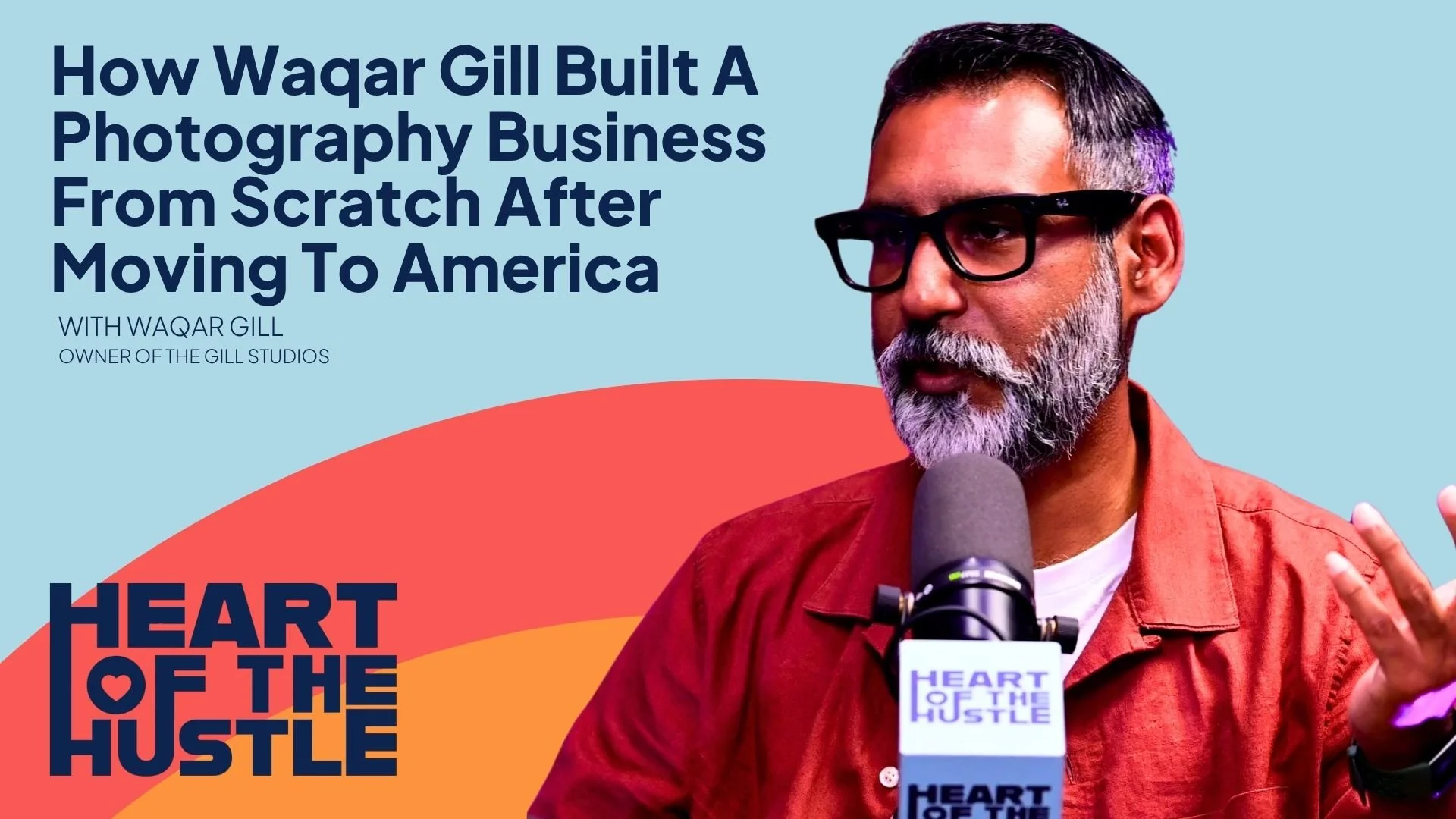
🌐 Website: https://thegillstudios.com/
By Sherry Sutton | Heart of the Hustle Show
My guest for Episode 50 spent thirteen years finding other people's mistakes for a living before he ever picked up a camera professionally. Here is what his story taught me about trust, speed, and what actually makes clients come back.
I have interviewed a lot of photographers on this show, and I am one myself, so I always go into those conversations a little differently. I know the gear talk. I know the chaos of trying to get the shot before the moment is gone. What I did not expect from my conversation with Waqar Gill of Gill Studios was how much of his success as a photographer actually traces back to a job that had nothing to do with cameras at all.
Waqar spent years as a quality assurance analyst at CVS. Before that, he worked at Walmart, in marketing, at banks, at mortgage companies. None of that sounds like the resume of someone who would eventually be photographing chamber award galas and grand openings. But by the end of our conversation, I understood exactly how that path led here, and I think his story has something to teach anyone building a creative business right now, whether you are behind a camera or not.
A Camera as a Graduation Gift
Waqar's story starts decades before Gill Studios existed, back in Pakistan, where his cousin gave him a Vivitar camera right after he finished high school. It was a basic two or three megapixel camera, nothing close to what he uses now, but it planted something. He was already drawn to art and design, already studying graphic design alongside it, and watching friends and family members work creatively only deepened that pull. He told me it was always there in the background, even when his life took him in a completely different direction for the next two decades.
The Long Road to Texas
That different direction started with immigration. Waqar and his family moved to the United States from Pakistan in 2008, the culmination of a process his uncle had started back in 1994. Fourteen years. I sat with that number for a while after we recorded. Fourteen years of waiting for a process most of us never have to think about.
He arrived during the recession, an only child bringing his parents along with him, and settled in Texas with family already living here. He likes to say he was not born in Texas but got here as soon as he could, and I love that line because it is true for so many of the most driven people I have met in this state.
Before any of that, back in Pakistan, he had studied computer science and then pivoted into business and marketing, drawn by a fascination with advertising and brand campaigns that he described as feeling almost like a fantasy world at the time. He had no idea then how much of that early interest would resurface later, both in how he eventually approached his photography business and in the entrepreneurial instincts he brought to it.
The Years That Built His Work Ethic
Waqar's first job in America was as a Walmart cashier. He got promoted into electronics because of his interest in tech, but he knew early on that this was not where he wanted to stay. His mother got sick during this period, and as her only child, he took on her care while still working toward finishing the master's degree he had started back home. He eventually earned a double master's in health system management and business administration from Texas Woman's University, something he describes as one of his proudest achievements, especially given how much weight education carries in his family and culture.
Somewhere in the middle of all that, he met the woman who would become his wife, while she was still living back home as a nurse. They spent years in a long distance relationship, married in 2011, and then spent two more years apart while visa processes worked themselves out before she could join him in the US in 2013. That same year, they both became citizens. He told me he considers this country his promised land, and I believed him completely when he said it.
Through all of this, he moved through a string of jobs that, on paper, look completely unrelated to photography. Marketing roles. Business to business sales. Banks. Mortgage companies. He eventually landed at CVS on the healthcare IT side, where he was hired as a quality assurance analyst. That job is where I think the real foundation for Gill Studios was quietly being built, even though neither of us would have guessed it at the time.
Why Quality Assurance Made Him a Better Photographer
This was one of my favorite parts of our conversation. I asked Waqar directly whether his QA background helped his photography, because as a photographer myself, I know how technical this work actually is. People assume you just point a camera and shoot, but the difference between an amateur shot and a professional one usually comes down to a hundred small technical decisions, the right shutter speed, the right white balance, the right setup for the specific light you are working with.
Waqar's answer stuck with me. He described himself as someone who naturally notices what is not working and wants to fix it, not in a critical or harsh way, but with a mindset of let's fix this together. That is quality assurance in a sentence, and it is also, it turns out, exactly the mindset a great event photographer needs. He gave me a small example that I have not stopped thinking about. If there is a coffee cup in someone's hand that is going to ruin the shot, you do not just plan to edit it out later. You ask them to set it down and take the shot correctly the first time. That instinct, catching the small thing before it becomes a bigger problem down the line, came directly from thirteen or fourteen years of QA work.
The Trip That Changed Everything
Waqar's mother passed away in 2015. Shortly after, a new job took him to California for seven weeks, based in Costa Mesa and Newport Beach. While he was out there, he bought his first real camera, a Canon from the T series, almost on impulse off an app. He spent that stretch of time exploring, going to the beach, visiting his cousin in San Francisco and a friend in Seattle, just taking pictures because he wanted to.
His wife flew out to meet him, and they took their first trip together as a couple, driving to Las Vegas and back in a single stretch. Neither of them drinks or smokes, so Vegas was not exactly their scene, but they walked the strip, had dinner, and came home having shot more than eight thousand photos on that trip alone. I find it striking that the camera that eventually built a business came into his life during one of the hardest years he had lived through. Grief and a new chapter showing up at the same time.
From Office Parties to "The Media Guy"
Back in Texas, Waqar started working at Triple-A's Dallas headquarters, and that camera came with him to every company event. Birthdays, team building activities, parties, he was the one capturing it and turning the footage into highlight reels for his coworkers. People started calling him the media guy, and he told me that is really where he first felt the spark, the sense that people genuinely valued what he was creating, even though none of it was professional yet.
The First Real Client and a Memory Card Disaster
The shift toward something real happened when his wife bought a Nikon D850, a purchase she had debated for a year and a half because of the cost. On their kids' last day of school, Waqar borrowed it and photographed the kids, teachers, and parents. He did some basic editing, nothing more than adjusting shadows and brightness, and the response from parents was immediate. People kept asking how he did it.
Not long after, he found his first actual client through a post on Nextdoor. She asked for a portfolio, which he did not have, and that conversation is what pushed him to build his first website within about a week. His very first paying client booked him for a graduation shoot, scheduled at the worst possible time of day for outdoor light, something he did not know yet to avoid. When he arrived, he discovered he had left his memory card at home in his computer. He had to ask his first paying customer to wait while he drove the five minutes back to grab it.
I love this story because it is so honest. He came back, took the photos, edited them as best he could, and the client was happy enough that she even offered to pay him later when her budget allowed. He told me he had no idea what to charge at that point, so he started researching other local photographers just to figure out a fair price list. That kind of humility in the beginning, willing to learn pricing from scratch instead of guessing, is something I see in almost every successful entrepreneur I have had on this show.
"He had to ask his first paying customer to wait while he drove the five minutes back to grab it. I love this story because it is so honest."
Investing in the Craft
As Waqar took on more community events, he realized his Nikon setup was holding him back. A camera, he told me, should feel like an extension of your body, not something you have to think your way through. He reached out to his wife's cousin, a photographer in Pakistan with over a decade of experience, who recommended a Sony A7III. Waqar went one step further and bought the newer A7IV instead, along with an 85mm portrait lens and a 24 to 70mm Tamron lens, a first investment of about five thousand dollars.
He told his wife he wanted to take this seriously, and her response was simple. She would support him, as long as he did not mess it up, and she trusted that he would not. Today, he carries somewhere between ten and fifteen thousand dollars worth of gear to every shoot, a camera body, two lenses, a GoPro, and an Osmo Pocket 3 for behind the scenes content. As a fellow photographer who has spent more than I would like to admit on lenses and lighting over fifteen years, I felt that part of the conversation in my bones.
Knowing the Difference Between Loyalty and Payment
One story that made me laugh during recording was when a martial arts dojo where Waqar trained asked him to shoot a full event, seven to eight hours, completely unpaid, simply because he was a student there. He told me he just laughed it off. I think that moment is a quiet but important lesson for anyone building a service business. Knowing your worth early, even in small, low stakes moments like that one, sets the tone for everything that follows.
The Turnaround Time That Built His Reputation
The story that I think best explains why Waqar's business actually grew came from a networking connection, a drone videographer he met who eventually hired him to shoot an airport hangar event for one of his clients. Waqar showed up, spent two and a half hours capturing the event in full, came home that evening, and had the entire edited gallery sent over by night's end.
His client was stunned. He told Waqar he usually waits two weeks for photos from other vendors. Waqar's answer was simple. He does not like making people wait, and he was never in a rush to get paid himself. What mattered to him was efficiency, delivering people their photos within a day or two at the most. That one job led to two or three more projects with the same client, including the Grand Opening of Goat Arena, which is where Waqar met the Little Elm Chamber, which, as it happens, is also how the two of us met.
How a Fast Turnaround Built a Whole Network
That referral chain kept going. A woman named Chelsea, who had met Waqar at Goat Arena, later reached out to ask if he would shoot the Chamber's annual awards gala, photographing roughly two hundred people throughout the night. She asked for just the winners' photos by the next day. Waqar got home close to eleven, waited for his kids to fall asleep, and then sat down and edited for about four hours, finishing around 2:30 in the morning. He had shot over seven hundred photos and narrowed the gallery down to around three hundred. When Chelsea reached out the next afternoon expecting just the award shots, he sent her the complete gallery instead, less than a full day after the event ended.
That same period pushed him to invest in a 70 to 200mm lens, something he had hesitated on for a while because of the cost, and shortly after that he landed a paid martial arts tournament gig, this time with agreed upon pricing from the start. None of this happened because he chased it aggressively. It happened because he consistently delivered fast, high quality work and let his reputation do the rest.
The Moment He Says Beats Everything
I ask almost every guest what success actually feels like to them, and Waqar's answer was one of the most specific I have gotten in fifty episodes. It is not about revenue or how many projects he has booked. It is the moment he sends someone their gallery, and later sees that exact photo become their profile picture. He told me that hits differently than any compliment ever could, because it means someone chose his work to represent who they are to the world.
As a wedding photographer myself, I understood that completely. I still have clients tagging me on their anniversaries, ten years after their wedding day, and there is something about that ongoing relationship with your own work, living on in someone else's life, that nothing else in this industry quite matches.
"It is the moment he sends someone their gallery, and later sees that exact photo become their profile picture. He told me that hits differently than any compliment ever could."
What He Believes About Editing and AI
We also got into a conversation I think more creatives need to be having right now, about AI in photography. Waqar has started using AI features inside Lightroom to enhance his editing, but he was firm about where the line sits. He will always do his best work for a client, but he will not turn someone into a version of themselves that does not exist. If someone has freckles, he works with them. If someone has acne, he softens it without erasing it. His goal is for people to look at their photos and recognize themselves, not wonder who they are looking at. I think that is one of the more thoughtful takes on AI I have heard from anyone in this industry, creative or otherwise.
Where to Find Gill Studios
If you are in North Texas and looking for an event photographer, you can find Waqar Gill at Gill Studios, on Instagram at Gill Photography, and on Facebook under the same name. After spending an hour with him, I would not hesitate to recommend him for anything from a corporate event to a milestone celebration.
Frequently Asked Questions
-
Waqar Gill is the founder of Gill Studios, an event photography business based in Texas. He was a guest on Episode 50 of the Heart of the Hustle podcast, hosted by Sherry Sutton.
-
Waqar Gill worked at Walmart, in marketing and business to business sales, at banks and mortgage companies, and ultimately as a quality assurance analyst at CVS while finishing his master's degree.
-
Sherry Sutton and Waqar Gill met through the Little Elm Chamber, after Waqar built a reputation locally through referral work, including the Grand Opening of Goats Arena.
-
Waqar Gill is known for fast turnaround, often delivering edited galleries within a day or two of an event rather than the two week industry norm, and for using AI to enhance rather than replace a subject's natural appearance.
-
Episode 50 of Heart of the Hustle, featuring Waqar Gill, is available on the Heart of the Hustle YouTube channel.
About Sherry Sutton
Sherry Sutton is a Personal Brand Architect and the founder of Heart of the Hustle Studio, where she helps entrepreneurs and professionals build visibility through video, podcasting, and personal brand strategy.
