
Ep 51 - From Software Engineer to Faith-Based Actor: Carter Nelms on Trusting the Leap
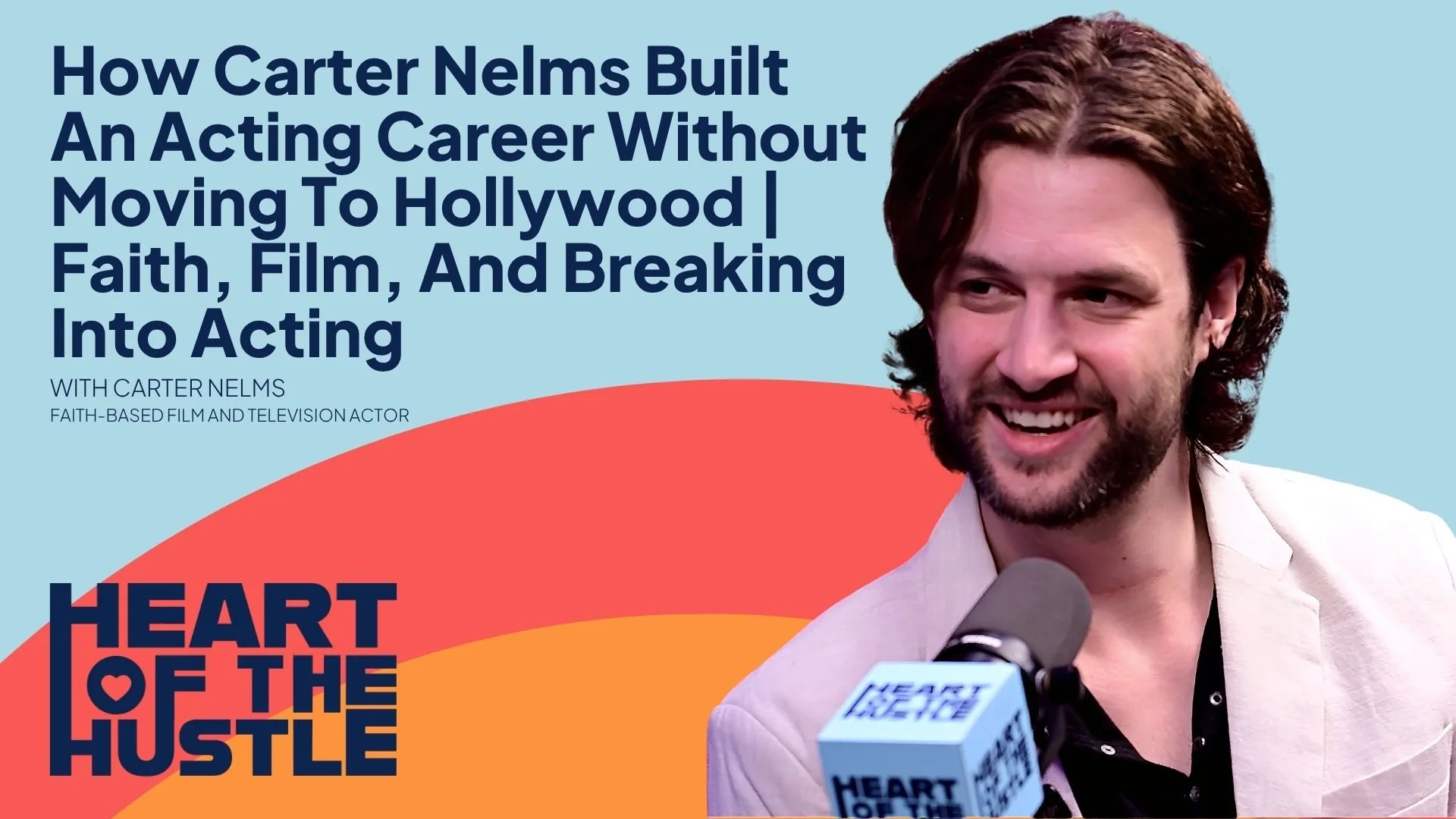
🌐 Website: https://carternelms.com/
By Sherry Sutton , Personal Brand Architect | Heart of the Hustle Show
How a self-tape shot on a cardboard box in a five-minute lunch break turned into a career built entirely on faith
I have interviewed a lot of guests on Heart of the Hustle, but Carter Nelms is our first full-fledged professional actor, and honestly, I did not know how much his story would apply to every single person listening, actor or not. Carter Nelms spent years as a mechanical engineer, then a software engineer, before walking away from that stability to become a faith-based actor. No agent discovered him in a coffee shop. No talent scout found him at nineteen. He built a career out of a self-tape shot in a five-minute lunch break, a cardboard box standing in for a tripod, and a decision to finally stop ignoring the pull he had been feeling for years.
This conversation with Carter Nelms is one of my favorite episodes we have ever recorded, because it is not really a story about acting. It is a story about timing, about listening to the thing you keep circling back to, and about what happens when you finally stop talking yourself out of it. If you have ever felt that tug toward something that scares you and buried it under a more practical plan, you are going to see yourself in this one.
Who Is Carter Nelms?
Carter Nelms is a Nashville-based actor known for his work in faith-based film and television, including his most recent release, Vindication: Search and Rescue, now streaming on Angel Studios and Redeemed TV. He also stars in The Pursuit, a social-media-first series following America's founding fathers, and has an upcoming project called The Servant, which will place him alongside recognizable names like Eric Estrada, John Schneider, and Kevin Sorbo.
But none of that was the plan. Carter Nelms went to college for mechanical engineering and never changed his major. He knew that was what he was going to do, full stop. There was no childhood theater bug, no drama department reputation, no clear signal pointing toward a life in front of a camera. He describes himself as notoriously left brained, the math guy, someone who did well in every class but never seriously considered the arts as a path.
The Unexpected Path Into Acting
Carter Nelms did one play in high school, the very last one before graduation, almost as an afterthought on a senior year bucket list. It was fun. It also was not, at the time, a signal of anything larger. He went on to study mechanical engineering, eventually pivoting into software engineering through Nashville Software School, one of the earliest coding bootcamps of its kind. He built an entire career in tech, one he genuinely loved. He was good at it. It paid well. The job market for developers stayed hot for years, and he had the kind of stability most people spend their whole lives chasing.
And still, something did not sit right. Carter Nelms describes it as an element that was always there under the surface, a sense that this was not the ultimate purpose, without knowing what to do about that feeling. He was not obsessing over it daily. It was just present, quietly, refusing to fully go away.
The shift started, as these things so often do, through a relationship. Carter Nelms dated a young woman for a few months who worked behind the camera in the casting world. Through her, he got a front-row seat to a process he had never seen before, sitting beside her while she reviewed self-tape submissions for a project, watching different actors interpret the same scene one after another. He was not saying anything out loud, but he was forming his own opinions on every tape. And more often than not, when he compared his read to her final decision, they lined up.
I finally just said, I've been thinking about it. Not saying it, but I keep seeing this all the time. And I got to admit, this looks like fun.
The Self-Tape That Changed Everything
She sent Carter Nelms a set of sides for a character that had already been cast for another project, just to see what he could do for fun. What followed is one of my favorite details in the entire conversation. They met on a lunch break, since he lived five minutes from work and she worked across the street. He had no tripod. What he did have was a large cardboard box, left over from a smoker he had received as a gift, which they stacked with a few books to hold her phone at a steady height.
That is the whole setup. A cardboard box, a stack of books, and one shot at a scene he had never formally trained for. Carter Nelms had never shot a tape before, so she walked him through the basics, eye line, awareness of space, the small technical things you only learn by doing them. But when it came to the actual performance, she let him go, because the point was not direction. The point was finding out what he could do.
He does not remember watching the tape back himself. What he remembers is her face. He recalls watching her expression light up as she said the words that would eventually rearrange his entire life: Carter, you need to be doing this. Not a polite compliment. Not a passing that was good. A full stop declaration, followed immediately by a plan, get headshots, get on Actors Access, start now.
What strikes me about this part of Carter Nelms' story is how much weight that single moment carried. He talks about needing that validation, needing someone with the authority he perceived in that world to confirm what he had only quietly suspected about himself. We all need that at some point. The difference is what you do once you get it.
Leaving Software Behind: The Leap of Faith
Belief in a calling and the practical reality of paying your bills are two very different things, and Carter Nelms does not gloss over that tension. He describes the safety net of software engineering, a field that was always easy to re-enter if acting did not work out. For a long time, he tried to hold both worlds at once, chasing acting roles while keeping one foot in tech as a backup plan.
Then came a single interview, for a job he actually wanted, one that paid well and involved genuinely interesting work rather than the insurance or banking software he had joked about with me during our conversation. He bombed it. Between an old sense of insecurity about staying too long at one company and the sting of a rejection for a role he actually wanted, something in him gave way. He realized that even if the odds of landing a similar software job were not zero, he would have to fight hard for a path his heart was no longer in.
That was the moment the safety net disappeared. Carter Nelms says he felt it physically, in his nervous system, for two full days.
The Rubber Duck Method and Prayer
This is where the conversation with Carter Nelms took a turn I did not expect, and it might be my favorite part of the whole episode. On the second day of sitting with that fear, his mind went, for the first time in his life, to the story of Peter stepping out of the boat to walk on water toward Jesus. Peter does not sink immediately. He starts walking. He only begins to sink once he takes his eyes off Jesus and focuses on the storm around him.
The absolute belief that it was God. And the question after that story was, do you believe that was God? And the answer was, I know that was God. Then what are you worried about? Just keep your eyes on him.
Two days later, at lunch with a friend who had no idea what he was working through, the same story came up out of nowhere, with a detail Carter Nelms had never noticed before, the reason Peter began to sink. He describes that as the only time in his life anyone has ever brought that specific point back to him unprompted.
As someone with a background in software engineering, Carter Nelms could not help but interrogate his own experience through a technical lens. He brings up the rubber duck method, a well-known practice in programming where explaining a problem out loud to an inanimate object, a literal rubber duck on your desk, often leads you to the answer simply through the act of articulating it. He wondered out loud whether prayer worked the same way for him, whether he was simply talking himself into clarity. It is a genuinely interesting question, and I appreciate that he did not pretend the analytical side of his brain just switched off the moment he found faith. He let both sides coexist, and that tension is part of what makes his story feel honest instead of polished.
Landing Vindication: Search and Rescue
Carter Nelms' most recent project, Vindication: Search and Rescue, released just over a week before we recorded this episode. It is available on Angel Studios and Redeemed TV, and it exists inside the world of the show Vindication, though he is quick to point out you do not need to have watched the series to follow the movie. He himself had not seen the original show before he was cast in it.
He is careful, and rightly so, about how much he reveals about his character, given how much the trailer intentionally holds back. What he will say is that his character arrives with a case for the show's primary detective to solve, one that seems almost comically minor at first glance before it slowly reveals itself to be connected to something much larger. The film was shot in the Dallas area in a ten-day shoot, a detail that still amazes me every time I think about how much has to come together to make that possible.
The Pursuit and Bringing History to Life
Carter Nelms also stars in The Pursuit, a project designed specifically for social media, broken into ninety-second episodes that piece together into what he estimates would run around forty-five minutes as a continuous short film. Each episode centers on a different founding father or mother arriving at a bar run by a fictional woman named Mary, played by Janine Turner, who also directs and produces the series. The show is releasing weekly, building toward America's two hundred fiftieth anniversary.
Carter Nelms auditioned for several of these historical roles, ultimately landing Patrick Henry. What struck me most in this part of our conversation was the research he did to prepare. He discovered that Patrick Henry had been caring for his terminally ill wife in the weeks leading up to his famous speech, and that she passed away shortly before he delivered it. Nothing in the speech itself references that loss directly, but understanding it shaped how Carter Nelms approached the role. He talks about Patrick Henry's case being fundamentally a moral one, not just a logical argument against a king, but an appeal all the way up to what he calls God's moral law.
Being a Faith-Based Actor in a Secular Industry
One of the more honest moments in this conversation is when I asked Carter Nelms how he navigates identifying as a faith-based actor within an industry that does not always make room for that. He talked about his early apprehension toward the entire idea of pursuing acting, tied to what he had seen happen to people who moved to LA or New York and, in his words, sold themselves for the industry. That was something he was determined to avoid from the start.
He believes there is a growing appetite for faith-based and what some call uplifting content, and he connects that shift to a broader cultural awakening he traces back through the last several years. His approach to his own career has been to look for purpose in the projects he chooses, while being clear that faith-based work does not need to be preachy to be meaningful. The Servant, his upcoming project, is a good example of that philosophy in action.
What's Next: The Servant
Carter Nelms' next project, The Servant, began as one concept and evolved into something larger after new opportunities opened up mid-production. His character started as a detective and has since shifted into a US Marshal, part of a larger ensemble of former military characters navigating their faith alongside a demanding, action-driven storyline. He will be sharing the screen with Eric Estrada, John Schneider, and Kevin Sorbo, a lineup he jokingly calls a motley crew.
He is careful not to oversell how overtly religious the show will be, describing it instead as an action series where the characters happen to be operating out of their faith rather than a show built to preach at its audience. Full production has not started yet, though Carter Nelms expects shooting to begin later this year.
Where to Follow Carter Nelms
If this conversation resonated with you the way it did with me, you can find Carter Nelms on Instagram, where he is most active, or through his own website, which he built himself, a nice full-circle nod to his software engineering background.
Hear the Full Conversation
This blog barely scratches the surface. Listen to the full episode with Carter Nelms on Heart of the Hustle, Episode 51, out now.
What I keep coming back to after this conversation is how ordinary the beginning of Carter Nelms' story actually was. No dramatic discovery. No overnight success. Just a cardboard box, a lunch break, and a decision to stop ignoring the thing he could not shake. If you are sitting in your own version of that moment right now, quietly circling something you have talked yourself out of more than once, I hope this story gives you the same nudge his self-tape gave him.
About Sherry Sutton
Sherry Sutton is a Personal Brand Architect and the founder of Heart of the Hustle Studio, where she helps entrepreneurs and professionals build visibility through video, podcasting, and personal brand strategy.
Ready to Turn Your Own Story Into Content?
Every episode we produce, including this one, comes from a system I teach start to finish inside Podcast To Payday. If you have a story worth telling and no idea how to turn one conversation into a full content engine, this is where you start.
